Wilson Neighborhood Recognized for Wildfire Risk Reduction

Arborists from Arbor Works Tree Service remove vegetation along a road corridor in Hidden Hills Ranches. Photo by Greg Nelson.

Hidden Hills Ranches, a subdivision south of Wilson, was recently recognized as a Firewise® USA site—a National Fire Protection Association program that recognizes neighborhoods for taking proactive steps to reduce the risk of property damage from wildfire and improve safety for residents and firefighters. The Hidden Hills neighborhood exceeded the expectations of the program after years of effort and implementing numerous wildfire risk reduction projects, with the support of local and regional partners including Jackson Fire/EMS, Bridger-Teton National Forest, Wyoming State Forestry Division, and Teton Conservation District.

 Hidden Hills resident Greg Nelson, also a Teton Wildfire Ambassador, has spent countless days planning and leading projects to make his neighborhood more fire resilient, including obtaining a Wyoming State Forestry Division grant to support fuels reduction at 18 properties. Other efforts included vegetation management along road corridors, and 11 homes participated in Teton Conservation District’s Wildfire Risk Reduction Program—a program that offers free, voluntary recommendations to reduce the risk of wildfire and grant funding to implement those recommendations. Cumulatively, the neighborhood has invested hundreds of hours into wildfire risk reduction efforts.

 “Becoming a Firewise community is no small effort—we thank Greg Nelson and his Hidden Hills neighbors for all they’ve done to enhance their safety, firefighter safety, and forest health,” says Bobbi Clauson, Wildland Fire Prevention Specialist for Jackson Hole Fire/EMS. “We can already see neighboring subdivisions gaining momentum from witnessing Hidden Hill’s successes.”

Project during and after photos to reduce vegetation along roads. Photo by Greg Nelson.

Hidden Hills is surrounded by forest and is within the Wildland Urban Interface—an area designated by Teton County as being at greater risk for wildfire. Wildfire risk reduction work has also been completed on adjacent Bridger-Teton National Forest lands as part of the Teton to Snake Fuels Reduction project. “While interagency wildland firefighters implemented fuels reduction projects on wildlands, the neighbors of Hidden Hills have worked diligently assessing homes, designing mitigation strategies, cutting trees, chipping vegetation, and burning slash piles on their properties to help reduce vegetation on the private side of the fence,” says Lesley Williams-Gomez, Fire Prevention and Education Specialist for the North Zone of the Bridger-Teton National Forest. “This combined effort in fuels mitigation has created a safe and defensible space for firefighters responding to a wildland fire within the vicinity of their homes.”

Shane Rothman and David Quellhorst contributing to fuels reduction work in their neighborhood common space. Photo by Greg Nelson.

But the work for Hidden Hills is not over. The neighborhood intends to maintain its Firewise® USA status and is planning future projects including annual road corridor maintenance and water sources for fire suppression. “The certification of Hidden Hills as a Firewise USA community was driven by the engagement of the homeowners, willingness to embrace fuels treatments, and a commitment to continue to improve fire readiness. Their passion and commitment made the certification possible,” says Barry Tye of Wyoming State Forestry Division.

To learn more about participating in the Firewise program or to learn more about other wildfire risk reduction actions you can take at your home or in your neighborhood, reach out to Bobbi Clauson, Wildland Fire Prevention Specialist, at 307-732-8588 or bclauson@tetoncountywy.gov.

5th Graders Stoked on Stewardship

Morgan Graham (Teton Conservation District), Meta Dittmer (Teton County Weed & Pest), Kari Cieszkiewicz (National Elk Refuge)

Munger Mountain 5th graders are stoked on pulling weeds! Sixty students teamed up with Teton County Weed & Pest District and the National Elk Refuge to learn about wildlife habitat and pull 100+ pounds of invasive weeds around their school. 

Over a series of field-based lessons, students learned about ecosystem processes and how to identify native and invasive plants. Following a field trip to an ecologically-intact site, they visited a school field that was disturbed by construction. In their own words, students described how the abundance and diversity of plants and wildlife was lower around the school.

Then, each class was asked how they could improve wildlife habitat around their school.

The students’ enthusiastic answer: “GET RID OF THE INVASVE PLANTS!!!” They pulled thistles, houndstongue, scentless chamomile, and other weeds…and because Jackson kids are tough, they did this during the first winter precipitation of the season! For the biggest common mallow, a team of kids pulled together like a game of tug-o-war, cheering and laughing when they triumphed over the tap root. As the piles of weeds grew bigger and bigger, the cumulative impact energized the kids even more.

Morgan Graham cultivating enthusiasm for eradicating weeds!

The students communicated the importance of being stewards of the habitat around their school and want to pass that value down to younger classes. Most people say they love wildlife…but not everyone knows what to do to help wildlife. These 5th graders figured it out pretty quick—their enthusiasm to help the ladybugs, butterflies, birds, and all the critters is contagious. We hope you catch the bug through this post—it’s not too late to get out there and pull some weeds this season!

Educators and students are excited to continue the project this winter with a mapping exercise to plan future restoration projects.

Meta Dittmer showing a houndstongue to students.

Kari Cieszkiewicz cutting down a musk thistle after all of the seeds were removed.

Students remove musk seed thistle heads.

What's the Ruehling on Fish and Flat Creeks?

Kelsey Ruehling (left) and field technician Emma Román, a senior at Middlebury college, collect water samples in Fish Creek in summer 2021.

University of Wyoming Master’s student Kelsey Ruehling (pronounced ‘ruling’) is on a mission to find out where microbial pollution in Fish Creek and Flat Creek is originating from.

Sections of both creeks were designated as “impaired” by the Wyoming Department of Environmental Quality in 2020 for Escherichia coli (E. coli), a bacteria found in the intestines of all mammals, including humans. There are more than 700 strains of E. coli which are expelled into the environment by their warm-blooded hosts through fecal matter. Most strains are either harmless or benefit a healthy digestive track, however, certain pathogenic strains of E. coli can cause stomach cramps, nausea, vomiting, and diarrhea. Because E. coli can be cultured quickly and inexpensively in a laboratory, these bacteria are often used by scientists as a proxy or indicator for fecal contamination and the presence of pathogens. The risk of illness from ingesting a pathogenic strain of E. coli or another fecal pathogen is why sections of Fish and Flat Creeks exceed recreational use standards, which means they are not considered safe by the Wyoming Department of Environmental Quality for full-body contact. 

In order to best mitigate sources of microbial pollution, we need current research to understand where it’s coming from. Kelsey spent the summer regularly sampling four sites on Fish Creek and seven sites on Flat Creek and its tributaries (Game and Cache Creeks). She also collected about 100 fecal samples near stream sites to identify which species may be contributing fecal bacteria to streams. Kelsey used two EPA-approved methods to quantify E. coli and extracted DNA from the water and fecal samples to characterize their bacterial communities. Kelsey hopes that studying E. coli and the bacterial community as a whole will improve our understanding of what kinds of fecal matter may be contributing to elevated levels of E. coli and other pathogenic bacteria in Flat and Fish Creeks.

Kelsey and Emma measure streamflow velocity at intervals across the creek.

“Kelsey’s research fills a much-needed data gap—where is fecal contamination in Fish Creek and Flat Creek coming from? Currently, we can guess or we can use 15-year-old data, but in the end, this research that will allow time and money to be allocated efficiently and generate the result we all want—water that is safe for humans, pets, and wildlife,” says Carlin Girard, Water Resources Specialist for Teton Conservation District.

The last time E. coli research was conducted in Fish Creek was in the early 2000s—that study found that over 50% of the E. coli load in the stream originated from avian, rodent, and deer/elk species. Less than 20% originated from sources related to human activities, including 7% from dogs, 6% from wastewater, 4% from bovines, and 2% from horses.

Kelsey completed data collection in summer 2021. She’ll spend this winter analyzing data and writing her thesis. Check back in to read about the results from Kelsey’s study in 2022.

Learn more about Kelsey’s research at www.kelseyruehling.weebly.com. This research is supported by Teton Conservation District, the Wyoming Water Research Program, Jackson Hole One Fly, University of Wyoming, and U.S. Geological Survey. 

Tom Segerstrom to Retire, Carlin Girard Welcomed as New Executive Director

Tom Segerstrom

Tom Segerstrom

Tom Segerstrom is retiring from his role as Teton Conservation District’s Executive Director after leading the District for six years. Carlin Girard, Teton Conservation District’s Water Resources Specialist & Associate Director, was selected as the new Executive Director.

“Over the past 15 years, I’ve witnessed Teton Conservation District’s community presence and partnerships grow, along with the caliber of our programs,” says Tom. “I’m proud to have participated in and help shape this culture—and it’s with great gratitude to our staff and board for making my time with the District, personally, very rewarding.”  

Prior to joining the District staff as Executive Director, Tom served on the Teton Conservation District Board from 2004 to 2015, including a term as Board Chair from 2011 to 2013. As a certified wildlife biologist, Tom was a District Biologist for Wyoming Game and Fish Department for six years, pioneered the local ecotourism industry, and worked for 15 years as a Land Steward and Staff Biologist for the Jackson Hole Land Trust.

Tom has served on several boards, including President of the Wyoming Chapter of the Wildlife Society, Chair of the Teton County Natural Resource Technical Advisory Board, Teton County Library, Wyoming Wildlife Federation, and Jackson Hole Wildlife Foundation. He is also a longstanding member of the noon Rotary Club.

Carlin Girard

Carlin Girard

Carlin Girard began at Teton Conservation District in 2014 as the Water Resources Specialist and gained the additional role of Associate Director in 2019. “Carlin is fully capable and well-suited to lead this local branch of government to become an even more significant resource for the community,” said Steve McDonald, Board Chair.  

Carlin built a successful Water Program with a focus on conserving the ecology of the Snake River Watershed through research, technical expertise, partnerships, and outreach. Carlin has a strong background in native fisheries, aquatic and riparian habitat, and surface water quality. As Carlin’s understanding of the local water systems increased, he expanded his focus to drinking water and wastewater, drawing the community’s attention to nitrate in groundwater and the need for regional water planning.

“I am honored to have been chosen as Executive Director, especially given the excellent position Tom has led us to.” Carlin emphasized that “the staff and board have clear direction and a strong working relationship, but we are also uniquely capable of adapting to community needs. We are this community’s partner for natural resource conservation projects, and I encourage members of the public, agencies, whomever, to reach out so we can help get your projects on the ground.”

Prior to joining Teton Conservation District, Carlin spent eight years working in natural resource management and research, including with Wyoming Game and Fish Department and Oregon Department of Fish and Wildlife, among many others. He is experienced in database management, statistics, and GIS mapping and analysis. He has worked with ungulates, waterfowl, passerines, raptors and a wide range of vegetation communities. Carlin has published peer-reviewed articles and technical reports and holds a Master of Science degree in Aquatic Resource Management from the University of Wyoming. Through Carlin’s work in Wyoming and the region, he has built strong partnerships with researchers, natural resource managers, landowners, and community leaders.

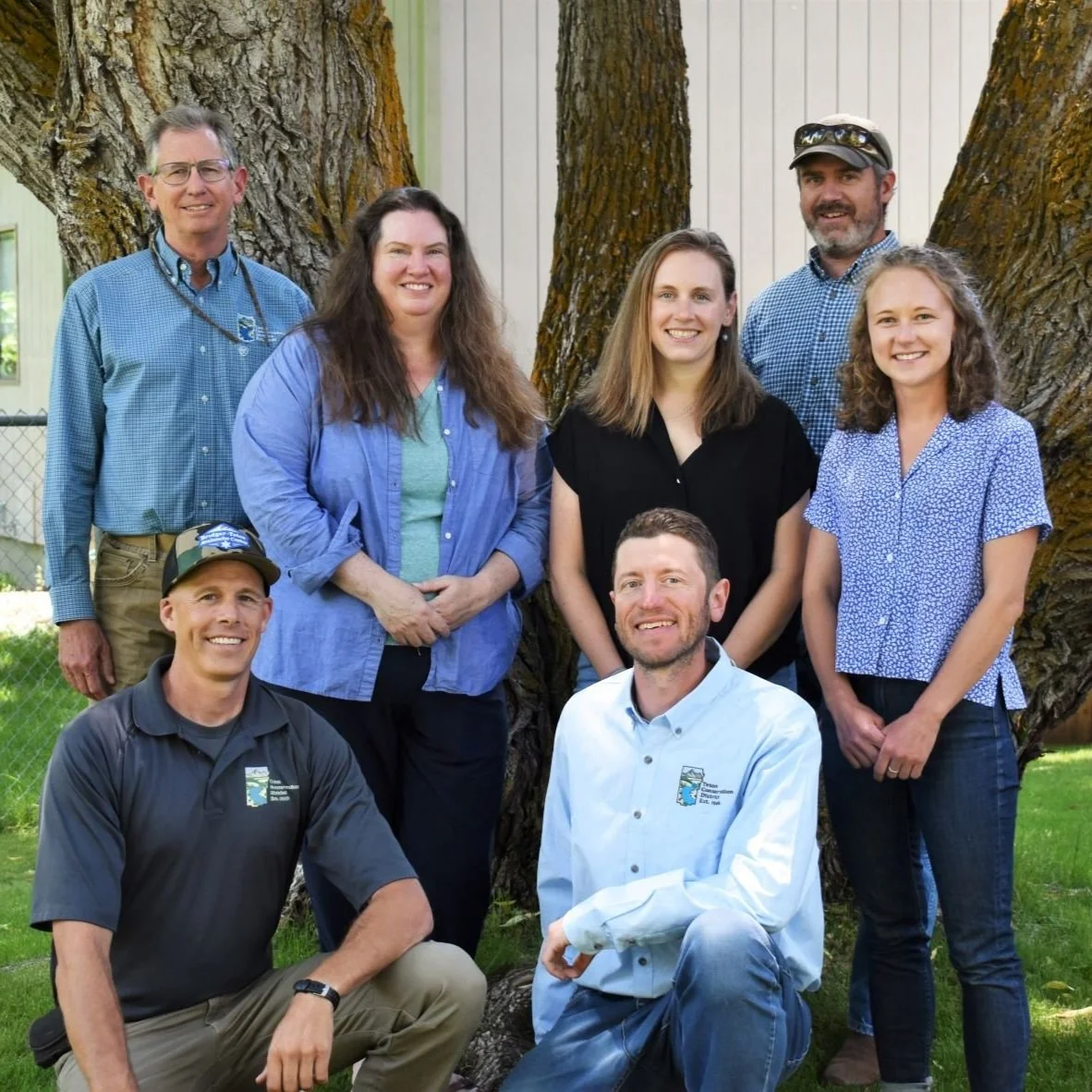
Top row left to right: Tom Segerstrom, Emily Hagedorn-Wegher, Emily Smith, Carlin Girard, Phoebe Coburn

Bottom row left to right: Robb Sgroi, Morgan Graham

Carlin and Tom in front of Teton Conservation District

DroughtReach Part II: Teton County is in Severe Drought

By Carlin Girard, Water Resources Specialist & Associate Director


OVERVIEW

Hello Teton County, Wyoming, it’s your local Teton Conservation District telling you it’s time to think about how we are using our water. We are a facing a record low water year, and seeing a record year for water use. We need to limit wasteful water consumption for landscaping and in our homes.

The western third of the United States is experiencing drought, and while Teton County isn’t experiencing worst case “Exceptional Drought” conditions like the desert southwest, our county is in “Severe Drought”. But what does that mean, and what should we be doing about it? We hope to answer some of these questions by presenting data and anecdotes, and we will offer some tried and true methods to reduce water consumption.

The Exceptional Drought conditions throughout the west really are no joke. This summer, Lake Mead, our Nation’s largest reservoir, hit all-time lows since its establishment in 1930. To reduce water use, counties in Nevada have begun banning ornamental grass that does not serve a direct purpose. And closer to home, JH Daily reported on June 15th, 2021, that Sun Valley Idaho’s Wood River ran so low this spring that its Magic Reservoir had to stop delivering irrigation water to the 36,000 acres of farmland that it supports, which is the earliest the reservoir had been drawn down completely since at least 1977.

By early April 2021, 100% of Teton County, Wyoming was classified as being in drought, and in mid- July, all portions of Teton County were upgraded to Severe Drought. Severe Drought conditions are defined by areas experiencing poor pasture conditions; overgrazing is reported; hay is scarce; producers are selling cattle; dust increases; trees and vegetation are stressed; water pressure is low; and, well levels decline. This tracks with what we are seeing in Teton County.

The Natural Resources Conservation Service reports that as of July 12th, 2021 the Upper Snake River Basin has received 79% of normal precipitation for this water year, which began October 1, 2020. Winter snowpack drives this region’s hydrology and based on meteorologist Jim Woodmencey’s analysis, this year’s meager snowpack encountered a dry spring and early summer, with cooler than normal temperatures from January through most of May being followed by much warmer than normal temperatures from late May through June 2021.


SURFACE WATER

The spring and early summer weather made quick work of the snowpack, melting out our high elevation water storage weeks prior to its typical disappearance. Very dry soil conditions that were present from last fall absorbed some of that water, sublimation (evaporation from snow to air) took its share, and the rest produced a quick but near average snowmelt runoff peak in our streams and rivers. The looser in this scenario is summer baseflows in our streams and rivers.

Of our many streams and rivers that have real-time USGS flow gages, we see that most are now either setting 30-year record lows for this time period or are about to. While historical data shows that streamflows have been this low before, these low flows coincide with times of severe drought. Unless a significant change occurs in precipitation regimes, there is no reason to believe that low flows in our rivers’ and their tributaries will increase. Instead, what we can expect is low flows, high stream temperatures, and difficult over-wintering conditions for our native fisheries due to restricted habitat availability. USGS temperature data shows that Flat Creek and the Snake River are nearing 10-year record highs for this time period, and are near or above the 70-degree threshold known to be stressful for cutthroat trout.

Discharge: USGS stream gage discharge data from some of our Upper Snake River gages. Click on the plot to expand it full-screen.

Max. Temperatures: Panel: An analysis of maximum temperatures at four gages that have temperature monitoring. Click on the plot to expand it full-screen.


GROUNDWATER

USGS Well at Jackson Hole Airport: This provides an analysis of groundwater water levels upgradient from the Jackson Hole Airport.

Drought is something that we should expect from time-to-time, but we should also expect the resulting decrease in water availability. And in Teton County, Wyoming, our surface waters are important for irrigation, aquatic ecosystems, and recreation, but it is groundwater that we humans really rely upon. Almost all of the region’s drinking water originates from groundwater. So, how does the groundwater situation compare to surface water scenario described above? They are tightly linked. In this area, the surface water can be seen as the water that spills over from the aquifer below it.

While groundwater depths are not being monitored as closely as streams, we do have data from a groundwater well upgradient from the Jackson Hole Airport which shows a very similar trend as our local streams—setting record lows for this date range compared to these is same dates throughout the 10 years period of data collect.

Interestingly, both data and anecdotes suggest that the same climatic conditions that have resulted in low stream flows and less groundwater are also contributing to record water usage, as landscaping irrigation demand has increased to keep grass green during this hot dry period. The Town of Jackson has reported that June water usage in 2021 was 165,816,910 gallons, compared to 143,252,081 for the same month in 2020. To make this a little more tangible, that’s an increase of more than 34 Olympic sized swimming pools of usage for the month of June. Other local water operators have also reported record daily water usage, and that landscape irrigation began weeks earlier this year.


What can i do?

Sometimes, we can rely upon others to address natural resources concerns. But it takes a whole community making individual contributions to address water use issues. Conservation Districts were created to address the fallout from the Dust Bowl. Trust us when we tell you that a proactive approach beats a reactive approach every time when it comes to water shortage.

As our residential and tourist populations increase, so does our demand and impact on water resources. Here are some actions you can take to help support the viability of our drinking water aquifers and aquatic ecosystems:

Morgan's Nature Notebook - Episode 9 - Birding by Ear

Do you like birds? But can't tell one from another? This episode is for you! Did you know that ornithologists (a.k.a. bird scientists) identify about 90% of species by their song or call! In this episode, Morgan offers some tips on learning to bird by ear!

Subscribe & like on YouTube! Share with your friends (kids & adults & animals)! If you think these videos are entertaining & informative, send questions and ideas for future episodes to info@tetonconservation.org.

Native Species Spotlight: Calypso orchid

Calypso orchid (Calypso bulbosa)! Also called fairy slipper or Venus's slipper, this delicate native spring flower is a special treat to see. If you are lucky enough to spot one, tread lightly—the Calypso orchid is considered vulnerable to extirpation or extinction. They are highly susceptible to even slight disturbances—trampling and picking are some of the primary reasons for its rapid decline in some areas. You won’t see Calypso orchids on high traffic trails frequented by people and dogs, and picking the flower will kill it—the roots are so delicate they will break at the slightest pull on the stem. Other stressors are logging and overabundant deer.

Calypso orchids grow in sheltered areas with little herbaceous competition—they especially like to put down roots in duff, the soft forest floor made up decomposing leaves, needles, twigs, bark, and other organic matter. They depend on bumblebees for pollination, and require a specific soil fungi! The genus Calypso derives its name from the Ancient Greek word meaning “to conceal” or “to hide”—in Greek mythology, Calypso, “she who conceals,” was a nymph who lived on the island of Ogygia.

IMG_20210609_185845080.jpg

DroughtReach Part I: What’s up with water? A look at snowpack and discharge

By Carlin Girard and Emily Smith

At Teton Conservation District, we like water. And behind the scenes, we work with water data to help forecast water issues and assist people in mitigating problems.

The analysis we present here is intended to help people visualize our current ‘water year’ from both a snowpack and water flow perspective. The first plot illustrates the snow water equivalent, a measurement of water in the snowpack. The second plot depicts Snake River discharge, a measurement of water flow. Both plots are shown with ‘water year’ on the x-axis (horizontal axis), which starts October 1st, when snow begins to accumulate in the mountains, and ends the following September 30th. A water-year is named for the year it ends on. Of note, we are in the midst of a drought year, and thus, we are presenting this year’s water data compared to 2016, which was a comparable water year, and 2001, which was a severe drought year. The plots also show median conditions, which represents ‘normal’ conditions.

Pro tip: Click on the plots above to see them full screen.

Starting in late summer of 2020, things got really dry – as in the driest soil moisture conditions in 10 years. And, as is shown in the Snowpack plot, the 2021 water year in the Upper Snake Basin has been at or below the median snow water equivalent. Over the month of May, typically one of our wettest months, snow water equivalent dropped from 64% to 57% of median, furthering our drought scenario. Now, an unseasonably warm and dry spring has caused a steep decline in the snowpack. The 2021 water year has been tracking close to the 2016 snowpack and discharge, although we have slightly less snowpack and have had a slightly higher peak discharge. As one of the driest winters on record, 2001 is presented as an example of extreme drought, which we have stayed above in both snowpack and discharge. The Green Knoll fire in Wilson was in July of 2001.

We present discharge measurements taken at the USGS Snake River monitoring station south of Jackson at Swinging Bridge (aka Snake River below Flat Creek) because it represents the water leaving Jackson Hole pretty well. Our guess is that the Snake River has already reached its peak flow (Glory Bowl is melted out) and it will be followed by a relatively rapid decline in discharge, especially considering that near-term temperature forecasts don’t show a cooling pattern. We eked out a decent whitewater peak, given the water year we had, but if our intuitions are correct, it’s time to start tying flies, because water levels will be dropping fast! Keep your eye on Rendezvous Bowl at Jackson Hole Mountain Resort – when it’s free of snow, the Snake is usually clear and beginning to fish well. And enjoy it, because according to the Bureau of Reclamation, they will be releasing higher than normal flows this summer from Jackson Lake, which can really hamper mainstem summer fishing conditions.

We are fortunate to have a substantial amount of surface and groundwater available even in a drought year, however, well owners, irrigators, firefighters, and anglers will need to pay special attention this summer and fall. If water supply has been an issue for you in the past, this year could present similar challenges.

Don’t hesitate to give us a call or an email if you observe abnormal water conditions this year, we are always interested.

Other resources:

Click here to check out NRCS snowpack data.

Click here to look at USGS Swinging Bridge Snake River data (multiple discharge readings per day and other data available).

Morgan's Nature Notebook - Episode 8 - Native Grass!

This episode of Morgan’s Nature Notebook was created for Wildlife Expo, an annual event hosted by the Jackson Hole Weed Management Association for all Teton County, Wyoming 4th-graders. In this lesson and activity, you’ll learn about native grass adaptations and how to plant your very own grass-terpiece! We hope it gets you excited about being a good wildlife and ecosystem steward by planting native habitat. Special thank you to the U.S. Fish & Wildlife Service/National Elk Refuge for partnering with us on this episode.

Dances with Wolves…and Elk

University of California Berkeley PhD student, Kristin Barker, and one of her field technicians, Zach Andres, posthole up a steep slope in the Gros Ventre Mountains, working their way towards a cluster of GPS points left by wolf collars a few days before. The points on their GPS screen indicate that the wolf pack stopped there. Could they have found a meal? Maybe they bedded down for the night? Wolves tend to bed on ridges or areas with good vantage points, and often will use terrain traps, like fallen timber or natural funnels, to hunt prey. We reach the top of the windswept ridge, and indeed, the wolf pack had stopped there for a rest. There are gentle depressions in the snow where each wolf hunkered down. Kristin kneels down at each bed to look for evidence that these were indeed wolf beds, typically confirmed by finding wolf hair. Kristin finds a hair and delicately holds it in her fingers, explaining that if the hair “kinks” when you bend it—like Kristin is demonstrating in this photo—it’s likely a hair from an ungulate, such as a moose, deer, or elk. Ungulate hair is hollow, while non-ungulate hair, like a human or wolf, is not hollow and does not kink.

Kristin Barker inspects a suspected wolf bed.

Kristin Barker inspects a suspected wolf bed.

Kristin Barker demonstrates how ungulate hair kinks because it is hollow.

Kristin Barker demonstrates how ungulate hair kinks because it is hollow.

The Jackson Elk Herd is an icon of Jackson Hole—the estimated 11,000 elk in the herd are ecologically, economically, and culturally important to our community and beyond. But in some ways, the species is still an enigma.

Part of the Jackson Elk Herd overwinters on the National Elk Refuge, but some winter higher up in the Gros Ventre drainage. The number of elk wintering in the Gros Ventre has varied unpredictably in recent years, ranging from 3,100 elk in 2012 to just 86 in 2017. Why?

The reasons for the stark differences from year to year are not well understood. Supplemental feeding efforts often—but don’t always—encourage elk to remain in the Gros Ventre, and concerns about the potential role of feedgrounds in disease transmission have led to discussions about reducing reliance on feeding as a management tool. Further, changing influences of wolf populations and human activities also affect elk distributions.

Kristin is working with Wyoming Game & Fish Department, the National Elk Refuge, Grand Teton National Park, and the U.S. Forest Service to identify factors that most strongly influence the winter distribution of the Jackson Elk Herd. With her team of field technicians, Kristin has spent the past three winters traversing the Gros Ventre Mountains, tracing the steps of collared wolves and investigating their prey species and bed sites. In the event that they find a wolf kill, they record the environmental circumstances like snowpack and vegetation type, as well as the condition of the animal by examining the teeth, joints, hooves, and bone marrow for signs of sickness or anything else that could have made the animal susceptible to predation.

Field Technician, Zach Andres, inspects an elk rumen.

Field Technician, Zach Andres, inspects an elk rumen.

Kristin and Zach record snowpack data.

Kristin and Zach record snowpack data.

Assessing the simultaneous effects of wolves, humans, and the environment will reveal the extent to which management actions can effectively manipulate elk distributions during winter. “We will learn, for example, whether elk distributions may be altered by changing the distribution of wolves on elk winter range, by changing elk feeding efforts, or by changing winter recreation regulations,” explains Kristin. “Alternatively, if we find that elk distributions are primarily driven by forces outside our control, such as snowpack or other environmental fluctuations, this information will allow managers to direct resources and efforts.” Kristin’s research may also help our understanding of CWD and disease transmission, human influence on wolf predation, and the number of elk killed by each wolf pack, which will help inform population objectives.

Kristin’s research is proudly supported by Teton Conservation District, Buffalo Bill Center of the West, the University of California, Berkeley, the Wyoming Game & Fish Commission, UW-NPS Small Grants Program, and Rocky Mountain Elk Foundation.

Wolves spotted on a ridge through a spotting scope. Photo by Zach Andres.

Wolves spotted on a ridge through a spotting scope. Photo by Zach Andres.

Morgan's Nature Notebook - Episode 7 - Winter Wildlife Closures

Do you like beta testing sick lines?? So do we. But, it's especially important to respect these last few weeks of wildlife closures. Why? Just because it's warm and sunny out does not mean the animals are “out of the woods." Sometimes their condition is so poor from the long winter, that winter kill actually happens well past when green up starts.

We know it's tempting, but stick with it and give wildlife the space they need until May. Most winter closure restrictions lift on May 1st. Click here to find a map of all winter closures in Teton County, Wyoming.

Snow Pile Removal Enhances Teton County Water Quality

Creeks and rivers throughout Jackson Hole will soon be swollen with snowmelt. In urban areas, melting snow carries sediment, salt, metals, hydrocarbons, and other pollutants deposited on roadways and parking lots throughout the winter into streams and rivers.  

Snow storage piles adjacent to waterways present an opportunity to protect water quality. With the support of Hungry Jacks General Store and Basecamp, Teton Conservation District (TCD) and the Jackson Hole Land Trust (JHLT) partnered with Teton Heritage Landscaping on a project initiated by the JH Clean Water Coalition (JHCWC) to remove the snow storage piles adjacent to Edmiston Spring.

Snow pile on March 4, 2021 before removal.

Snow pile on March 4, 2021 before removal.

Snow pile on March 12, 2021 after four dump-truck loads were carried away.

Snow pile on March 12, 2021 after four dump-truck loads were carried away.

Edmiston Spring is a small, spring-fed tributary to Fish Creek. It bubbles up on the east side of Owen Bircher Park, meandering through downtown Wilson for about a half a mile before meeting its confluence with Fish Creek. Edmiston Spring is a valuable nursery for juvenile Snake River cutthroat trout and provides aquatic and wetland habitat for numerous other species. Excess sediment, especially fine silt, clogs up loose gravel streambeds, which are critical for both trout and macroinvertebrate reproduction cycles.  

Teton Heritage Landscaping transported four dump-truck loads of snow away from the spring. Just how much sediment did this prevent from entering the spring? Trevor Deighton’s Jackson Hole Middle School 8th grade science class investigated that question. Deighton’s students melted down 22 liters of snow and filtered out the sediment. Averaging the values, they estimated that the four dump truck loads of snow prevented approximately 4,783 gallons of water of questionable quality and about 1088 pounds of sediment from draining into the spring.

“The results of the investigation by the young minds at the middle school illustrate how small actions by the community can have big impacts to the water quality of Teton County,” notes JHLT Director of Stewardship Derek Ellis. “The Jackson Hole Land Trust is proud to be a partner of the JH Clean Water Coalition to help protect the waters of the Greater Yellowstone Ecosystem.”  

“This project, despite its small size, has a big community and ecological benefit,” says Carlin Girard, Teton Conservation District’s Water Resources Specialist & Associate Director. “We hope it inspires others to consider snow storage locations that are close to streams and waterbodies, and pursue snow storage removal projects that could have a large cumulative impact on water quality throughout the valley.”

This small project builds on the Edmiston Spring Channel Enhancement Project, a collaborative effort that began in 2015 to improve aquatic and wetland habitat. Partners of that project included Wyoming Game & Fish Department, Jackson Hole Trout Unlimited, Friends of Fish Creek, Teton Conservation District, and the Snake River Fund.

Snow pile adjacent to Edmiston Spring on March 4, 2021, before removal.

Snow pile adjacent to Edmiston Spring on March 4, 2021, before removal.

Snow pile on March 12, 2021 after four dump-truck loads were carried away.

Snow pile on March 12, 2021 after four dump-truck loads were carried away.

Happy Plant a Flower Day!

These sunny days make it feel like spring is just around the corner…it’s also Plant a Flower Day! To celebrate, enjoy these pictures and fun facts “cultivated” by our very own Morgan Graham, GIS & Wildlife Specialist for Teton Conservation District:

Bonneville shooting star: Bumblebees hang upside down on stalk and vibrate their wings at a frequency that releases pollen on their belly.

Bonneville shooting star: Bumblebees hang upside down on stalk and vibrate their wings at a frequency that releases pollen on their belly.

Harebell/bluebell bellflower/witch's thimble: The name alludes to the folk beliefs that this flower grew in places frequented by hares or that witches used juices squeezed from the flower to transform themselves into hares. The Haida people of the P…

Harebell/bluebell bellflower/witch's thimble: The name alludes to the folk beliefs that this flower grew in places frequented by hares or that witches used juices squeezed from the flower to transform themselves into hares. The Haida people of the Pacific Northwest called them "blue rain flowers" and it was thought that picking them would cause it to rain.

Yellow fritillary: Bears and rodents eat the bulbs, that taste like potato when fresh and rice when cooked.

Yellow fritillary: Bears and rodents eat the bulbs, that taste like potato when fresh and rice when cooked.

Silky phacelia: Deters herbivores by synthesizing cyanide from amino acids. Also keeps the graze away by hyperaccumulating gold. Plants found in vicinity of gold mines have 10 - 100x the gold concentration as the surrounding soil!

Silky phacelia: Deters herbivores by synthesizing cyanide from amino acids. Also keeps the graze away by hyperaccumulating gold. Plants found in vicinity of gold mines have 10 - 100x the gold concentration as the surrounding soil!

Orange agoseris aka mountain dandelion: Fun to say, reminds @morganser of Animal from muppets. Probably other fun facts about this flower too, but that one is pretty fun.

Orange agoseris aka mountain dandelion: Fun to say, reminds @morganser of Animal from muppets. Probably other fun facts about this flower too, but that one is pretty fun.

Northwestern Indian Paintbrush/Showy Northwestern Indian Paintbrush/Desert Paintbrush: Attracts pollinators like hummingbirds and butterflies. Various parts of the plant were historically used for stomach pains, sore eyes, and to regulate menstruati…

Northwestern Indian Paintbrush/Showy Northwestern Indian Paintbrush/Desert Paintbrush: Attracts pollinators like hummingbirds and butterflies. Various parts of the plant were historically used for stomach pains, sore eyes, and to regulate menstruation.

Arctic Gentian: King Gentius, ruler of Illyria (modern day SE Europe) valued this species for its ability to cure malaria in his troops.

Arctic Gentian: King Gentius, ruler of Illyria (modern day SE Europe) valued this species for its ability to cure malaria in his troops.

Don't Feed Wildlife

A storm's a brewin! Bambi struggling through the deep snow this weekend may tug at the heartstrings. Some kind folks out there may think it’s a good time to put out snacks for our wild neighbors. While they mean well, feeding wildlife—and mule deer in particular—does more harm than good:

#1 Mule deer have microorganisms in their digestive system that gradually change with the seasons, allowing them to eat different naturally-occurring foods throughout the year. A rapid transition from high-fiber woody browse to high-carb/protein human-provided foods (like hay, corn, livestock feed, birdseed, or basically anything from a store) can mess up a deer’s stomach and kill it. Feeding can lead to conditions in ruminants called acidosis (carb overload) and enterotoxemia (overeating), which will kill a mule deer in 24-72 hrs. Symptoms include convulsions, diarrhea, weakness, and more. You may see Bambi happily munching on feed, but it could walk away and get sick in the ensuing hours.

#2 Feeding wildlife is against Teton County regs and you can get fined up to $750 a day! Learn more at tetoncountywy.gov/657/Wildlife-Feeding-Violations.

#3 When mule deer concentrate at feeding locations, it creates ideal conditions for increased loss due to predation and diseases. And, attracting predators into neighborhoods presents other problems…

#4 Supplemental wildlife feeding in residential areas may increase wildlife-vehicle collisions. Animals change their movement patterns to reach feeding sites, which means they might cross roads more often.

#5 Feeding can disrupt natural behavior. If a deer is conditioned to remain near a feeding site, it might not migrate from its winter range to its summer range. Over the long-term, this will compromise the population as a whole. Fed deer also tend to lose their fear of people, which can negatively affect survival. And, when food is concentrated, deer compete and exclude smaller and weaker deer, inadvertently leading to starvation.

What can you do? Spread the word! You can also report violations to Teton County’s Code Compliance Officer at 307-733-3959.

Teton Conservation District Celebrates 75 Years!

Happy 75th Birthday Teton Conservation District!

Anniversaries like this offer a moment to pause and reflect on history. In celebration of our conservation heritage, we’re reflecting on how Teton Conservation District came to be. But, these last 75 years of conservation work are a mere blip in the 11,000-year history that humans have been connected to and made a living on this landscape. So, we’d like to honor not just our recent history, but the thousands of years that indigenous peoples and newer residents have stewarded this landscape. We continue appreciate the opportunity to work with our surrounding communities to conserve natural resources in Jackson Hole and beyond.

Feeding Cattle, 1954.

Feeding Cattle, 1954.

Showing the growth of tame hay, 1961.

Showing the growth of tame hay, 1961.

Cache Creek Flood, 1974.

Cache Creek Flood, 1974.

4H Camp Soil Lesson, 1975.

4H Camp Soil Lesson, 1975.

Our story begins with the Dust Bowl. As a result of severe drought, exacerbated by years of unsustainable agricultural practices, the Dust Bowl ravaged the west in the 1930s. Taking action to conserve soil and prevent erosion, Congress passed the Soil Conservation Act of 1935, which created the Soil Conservation Service (now called the Natural Resource Conservation Service), administered by the United States Department of Agriculture. In 1937, a model Soil Conservation District Law was developed and sent to each state governor, along with a letter from President Franklin D. Roosevelt urging them to empower local farmers and ranchers to create districts to conserve soil and water resources. Wyoming passed the Soil Conservation Act in 1941, leading to the voluntary formation of local conservation districts across the state. Today, there are 34 conservation districts in Wyoming.

During the coldest and darkest months of 1946, a committee of Jackson Hole residents including Jim Imeson, Cliff Hansen, Arthur Brown, Bruce Porter, Fred Toppings, and Amasa James came together and established Teton Soil Conservation District. Over the years, our name changed to Teton Conservation District and our boundaries expanded to include Grand Teton National Park and Wyoming’s portion of Yellowstone National Park. Since 1998, voters within the district area have approved up to one mill of property taxes every four years to fund the conservation district for the purpose of soil, water, wildlife, and other conservation programs.

Rooted in public support, 75 years of Teton Conservation’s District’s work demonstrates our dedication to our community and environment. With ever-increasing demands on the natural world, Teton Conservation District is committed to working with the community to carry out our shared vision for a better future. To learn more about what’s on the horizon, check out our 2020-2025 Strategic & Long-Range Plans.

 
TCD75th.jpg
 

An Excerpt from Winter Wings by Bert Raynes

An excerpt from Winter Wings by Bert Raynes:

"There's an old geologist's saying to the effect that if he hadn’t believed it, he would have never seen it. I actually knew that old geologist.

Finding birds in winter in the Northern Rockies is a little like searching for some previously unrecognized subtle or hidden geomorphic feature. They’re there, but if you don’t believe, you’ll never see them.

Different from summer or spring. What should your winter birding strategy, be, then??

Just go out and look.

Many bird watchers think summer is the optimum time to find birds. True enough, there are more birds around. More species, more numbers of most species. True, but many birds are on the nest, quiet, and don’t want to be seen, or are busy feeding and training their young and are no longer singing. Some are hiding out as only they can.

Summer birds are great. But winter birds, they’re hardy souls with fewer obligations. Every wild creature has to be concerned about its safety and food. Winter birds have pretty much only those concerns—not territorial defenses, not mate selection, not eggs to brood, nor young to care for. Why, winter birds are almost on vacation! What better time to look for them?”


Thank you for making us believe Bert, and for teaching us to appreciate the natural world. Thank you for shaping the next generation of naturalists and conservationists. Bert Raynes, naturalist and Jackson Hole icon, passed away on New Year's Day at age 96.

There may be fewer birds around, but some birds only ever show up in winter! Winter is your best chance of seeing cool little guys like grosbeaks (pine and evening), crossbills (red and white-winged), rosy-finches (black and gray crowned), northern shrikes, and snow buntings…in the valley bottom. Raptors like rough-legged hawks and the occasional snowy owl only ever migrate south to Wyoming during the winter months. If you’re a beginner birder, winter is a great time to get familiar with a good foundation or hardy souls.

Pine grosbeak by Yankech Gary

Pine grosbeak by Yankech Gary

Gray-crowned rosy-finch by Dominic Sherony

Gray-crowned rosy-finch by Dominic Sherony

Snow bunting by Andy Reago & Chrissy McClarren

Snow bunting by Andy Reago & Chrissy McClarren

Snowy owl by Jongsun Leend

Snowy owl by Jongsun Leend

White-winged crossbill by Scott Hero

White-winged crossbill by Scott Hero

Northern shrike by Andy Reago & Chrissy McClarren

Northern shrike by Andy Reago & Chrissy McClarren

Rough-legged hawk by Tom Koerner/USFWS

Rough-legged hawk by Tom Koerner/USFWS

Morgan's Nature Notebook - Episode 6 - Winter Tracking

Winter tracking is an art! For all you non-tracking-artists out there, enjoy these beginner tips for learning to recognize stories written in the snow by animal tracks and signs.

With sub-zero temps and a deepening snowpack, it’s becoming more important to give wildlife space. The energy an animal expends running from a person, dog, or car is energy they might have a hard time replenishing with limited browse and forage available over the winter. But, learning to identify tracks is a fun way to connect with the natural world and wildlife without needing to get close them, or even see them at all!

If you want to become an expert tracking artist, a good place to start is this U.S. Forest Service chapter by Halfpenny, Thompson, Morse, Holden, and Rezendes on snow tracking. Another great resource to look for at the library or book store is Mammal Tracks & Sign by Mark Elbroch.

Across the Aisle—Washington agrees on historic funding for conservation

By Morgan Graham 

Morgan Graham wrote this piece for the Wyoming Chapter of the Wildlife Society’s 2020 Fall Newsletter. We’ve reposted it here on Teton Conservation District’s blog to provide summary of the recently passed Great American Outdoors Act, a law that addresses mounting maintenance costs of federal land and permanently funds the Land and Water Conservation Fund. It passed the House and Senate with unusual bipartisan support, with 310 of 435 Representatives and 73 of 100 Senators supporting the bill.


As we approach election day, bipartisanship seems like an invertebrate on the endangered species list—obscure and rare.

To juxtapose, let’s take the opportunity to highlight the recently passed Great American Outdoors Act (GAOA), a law that addresses mounting maintenance costs of federal land and permanently funds the Land and Water Conservation Fund (LWCF). Late civil rights luminary Representative John Lewis introduced the original bill as the Taxpayer First Act in 2019, but the bill underwent substantial revisions over the following year and a half. President Donald Trump signed the bill into law on August 4th, 2020.

Existing funding is not sufficient to meet the mounting cost of conservation in the United States. The GAOA helps to cover conservation funding gaps via two mechanisms: the National Parks and Public Land Legacy Restoration Fund (NPPLLRF) and the Land and Water Conservation Fund (LWCF).

Jenny Lake Trail in Grand Teton National Park.

Jenny Lake Trail in Grand Teton National Park.

Under the NPPLLRF, 50% of all federal tax revenue from oil, gas, coal, or alternative energy developments on federal land or water over the next 5 years will be deposited into a fund, up to a maximum of $1.9 billion annually. From this fund, 70% will be allocated to the National Park Service, 15% to the U.S. Forest Service, and the remaining 15% split equally amongst the U.S. Fish and Wildlife Service, Bureau of Land Management, and Bureau of Indian Education. Nearly $20 billion are necessary to address maintenance backlogs on federal lands, and NPPLLRF will help with this backlog. Projects will prioritize improved accessibility for persons with disabilities. At least 65% of funding within each agency will support maintenance on docks, restrooms, campground, and trails projects, and remaining funds may support paved/unpaved roads, bridges, tunnels, and paved parking. After 5 years, the General Accounting Office will conduct a study to examine the efficacy of the NPPLRF.

Bighorn Canyon National Recreation Area. Photo by National Park Service.

Bighorn Canyon National Recreation Area. Photo by National Park Service.

The GAOA also permanently funds the LWCF, a law that has previously required funds to be allocated on an annual basis. The LWCF was established in 1964 and is primarily financed by royalties on offshore drilling, with a small percentage generated from the sale of federal lands and taxes on boat fuel. Since its inception, nearly $20 billion have been allocated to federal, state, and local governments to improve access to recreation and protect natural resources. The LWCF was reauthorized—but not funded—in 2019, reducing a substantial pool of funding opportunities for many governmental agencies. However, with the passage of the GAOA, the LWCF has secured $900 million per year. In Wyoming, the vast majority of LWCF grants have helped establish or redevelop community recreational amenities such as parks, golf courses, ball fields, shooting ranges, rodeo grounds, and ski lifts. Notable habitat conservation projects supported by LWCF include the Bear River Watershed Conservation Area, the Bighorn Canyon National Recreation Area, Cokeville Meadows National Wildlife Refuge, Fossil Butte National Monument, and the North Platte River Special Recreation Management Area.

Despite broad bipartisan support, the Wyoming Congressional delegation unanimously opposed the legislation. Senator Mike Enzi asserted the act contributed to the national debt and failed to account for the federal maintenance costs beyond five years. Senator John Barrasso expressed support for the LWCF and its positive impact on communities throughout Wyoming, but he did not support the bill over concerns about long-term maintenance funding and the federal government continuing to bite off more than it can chew. Representative Liz Cheney expressed dismay that taxpayer dollars would support the conversion of private land to public without a viable plan for funding the existing maintenance bill.

Most media outlets have considered the GAOA the biggest win for conservation in a generation. It passed the House and Senate with unusual bipartisan support, with 310 of 435 Representatives and 73 of 100 Senators supporting the bill. With 92% of federal lands occurring in 12 western states, politicians effectively lobbied for its passage as an economic stimulus for economies of the Mountain West. With the exponential increase in outdoor recreation, reliable funding for public land infrastructure is a priority. Here’s hoping this uncommonly popular piece of legislation can help.